
Abstract
This essay examines the life and historical significance of Muhammad as both a prophet and statesman whose leadership transformed the religious, political, and social landscape of seventh-century Arabia. It analyzes the conditions of pre-Islamic Arabia, including tribal fragmentation, polytheistic religious practices, and the geopolitical pressures exerted by the Byzantine and Sassanian Empires. The essay explores Muhammad’s early life, the beginning of revelation, and the emergence of Islam as a monotheistic movement centered on moral reform, communal solidarity, and social justice. Particular attention is given to the persecution of early Muslims in Mecca, the migration to Abyssinia, and the Hijra to Medina, which marked a decisive turning point in the formation of the Muslim community.
The study further examines Muhammad’s role in building Medina into the political, administrative, and intellectual center of the emerging Islamic state. Through institution-building, diplomacy, military organization, and religious leadership, Muhammad helped transform tribal Arabia into a broader political and religious community united under the concept of the ummah. The essay also analyzes major events including the battles of Badr, Uhud, and al-Khandaq, the Treaty of Hudaybiyyah, and the peaceful conquest of Mecca. It argues that Muhammad’s leadership laid the foundations for the unification of Arabia and for the emergence of a civilization whose influence extended far beyond the Arabian Peninsula after his death in 632 CE.
Introduction
Muhammad ibn Abdullah emerged in seventh-century Arabia not only as the founder of Islam but also as a transformative religious, political, and social leader whose message reshaped the moral and political landscape of Arabia. Muslims regard Muhammad as the final prophet in a long line of monotheistic messengers that includes Adam, Noah, Abraham, Moses, and Jesus. Islamic tradition presents him as both a prophet and a statesman who united the tribes of Arabia under the principles of monotheism, justice, and communal solidarity.
The name Muhammad means “praised” or “commendable” in Arabic and derives from the Arabic root hamida, meaning “to praise.” According to early Muslim genealogists, Muhammad’s lineage traces back to the Prophet Abraham through the line of Ishmael. He was born in Mecca around 570 CE, a year traditionally remembered in Islamic history as the “Year of the Elephant,” referring to the failed expedition of Abraha, the Abyssinian ruler of Yemen, against the Ka‘ba.
At the time of Muhammad’s birth, Arabia was characterized by tribal fragmentation, intertribal rivalries, and a largely polytheistic religious environment. Nevertheless, Mecca occupied an important commercial and religious position in western Arabia due to its role as a major caravan center and as the site of the Ka‘ba, which attracted pilgrims from across the Arabian Peninsula. Muhammad’s life and teachings would eventually contribute to the transformation of this fragmented tribal society into a broader religious and political community known as the ummah.
Muhammad: Early Life and Formation
Muhammad was born into the Banu Hashim clan of the Quraysh tribe, the dominant tribe of Mecca and the custodian of the Ka‘ba. His father, Abdullah ibn Abd al-Muttalib, died several months before his birth, and his mother Aminah died when he was approximately six years old. Following Arab custom, Muhammad first came under the care of his grandfather Abd al-Muttalib and later his uncle Abu Talib, both respected figures within the Quraysh community.
Islamic tradition consistently portrays Muhammad as possessing exceptional moral character from an early age. He became known among the Meccans as al-Amin (“the trustworthy”) because of his honesty and reliability in commercial and social affairs. Early Muslim biographical sources describe him as contemplative, generous, restrained, and deeply concerned with the moral condition of his society.
As a young man, Muhammad worked as a shepherd and later participated in long-distance trade caravans traveling north toward Syria. Early Muslim sources report that he accompanied his uncle Abu Talib on commercial journeys while still young, gaining experience in trade and exposure to the broader political and religious environment of the Near East. Around the age of twenty-five, Muhammad entered the service of Khadija bint Khuwaylid, a wealthy Meccan merchant widow whose commercial ventures he managed successfully. Impressed by his integrity and character, Khadija later proposed marriage.
Their marriage endured for approximately twenty-four years until Khadija’s death and played a central role in Muhammad’s emotional and social stability during the earliest period of revelation. Muslim sources portray Muhammad as a devoted husband and father deeply attached to his family. Although several children were born from the marriage, only his daughters survived into adulthood. Khadija herself became Muhammad’s earliest supporter and the first believer in his prophetic mission.
Muslim sources also emphasize that Muhammad did not actively participate in many of the religious practices associated with Arabian polytheism. Instead, he increasingly sought solitude and reflection, particularly in the cave of Hira near Mecca, where he would contemplate, meditate and pray. Islamic tradition further maintains that Muhammad was unlettered (ummi), meaning that he neither read nor wrote, though he consistently encouraged learning, reflection, and the pursuit of knowledge among his followers.
At the time, poetry occupied a highly respected position within Arabian society and served as a principal medium for preserving tribal memory, genealogy, and reputation. Yet Muhammad was not known as a poet nor associated with the composition or recitation of poetry. This distinction later became important within Islamic tradition, which emphasized that the Qur’an differed fundamentally from conventional Arabic poetry in style, structure, and religious message.
According to Islamic tradition, Muhammad began receiving revelations from God through the Angel Gabriel at approximately forty years of age. The revelations continued over a period of approximately twenty-three years and were eventually compiled into what became known as the Qur’an. Muslims regard the Qur’an as the literal word of God revealed in Arabic, while historians generally approach it as the foundational scripture of the emerging Muslim community. Islamic tradition consistently portrays Muhammad as a human prophet and messenger rather than a divine figure endowed with supernatural status.
Muhammad as Prophet
According to Islamic tradition, Muhammad began receiving revelations from God through the Angel Gabriel in 610 CE while meditating in the cave of Hira near Mecca. The first revealed verses, preserved in Surat al-‘Alaq, instructed him to “Read in the name of your Lord who created.” The experience profoundly affected Muhammad, who initially feared for his wellbeing before being comforted and reassured by his wife Khadija. Early Islamic sources report that Khadija consulted her relative Waraqa ibn Nawfal, who was familiar with Jewish and Christian scripture and who reportedly affirmed that Muhammad’s experience resembled those of earlier prophets.
The revelations continued intermittently over approximately twenty-three years and were eventually compiled into what became known as the Qur’an. Muslims regard the Qur’an as the literal word of God revealed in Arabic, while historians generally approach it as the foundational scripture of the emerging Muslim community. The Qur’an repeatedly situates Muhammad within a longer line of monotheistic prophets that includes Adam, Noah, Abraham, Moses, and Jesus. Islamic tradition therefore presents Muhammad not as the founder of a completely new religion, but as the final messenger entrusted with restoring and reaffirming the monotheistic message associated with earlier prophets.
Muhammad’s earliest message centered on uncompromising monotheism, social justice, moral accountability, and rejection of idol worship. He called upon the people of Mecca to abandon tribal arrogance, economic exploitation, and devotion to idols and instead worship the one God. This message attracted members of Muhammad’s close circle, including his wife Khadija, his cousin Ali ibn Abi Talib, his close friend Abu Bakr, and a growing number of followers from different tribal and social backgrounds. Among the earliest converts were also socially marginalized individuals, including slaves such as Bilal ibn Rabah, whose acceptance of Islam reflected the appeal of Muhammad’s message among vulnerable segments of Meccan society.
As the Muslim community gradually expanded, opposition from Meccan leaders intensified. The Quraysh elite viewed Muhammad’s teachings not only as a religious challenge but also as a threat to Mecca’s social order, tribal hierarchy, and pilgrimage economy centered around the Ka‘ba. Early Muslims faced ridicule, social boycott, economic pressure, and at times physical persecution. Those lacking tribal protection, especially slaves and poorer converts, suffered particularly harsh treatment.
Unable to guarantee the safety of all his followers, Muhammad encouraged some Muslims to migrate to Abyssinia in 615 CE, where they sought protection under the Christian ruler known in Islamic sources as the Negus (Najashi). Islamic tradition portrays the Negus as a just ruler who refused Meccan demands to extradite the Muslim migrants after hearing their defense and learning about Islamic teachings concerning Jesus and Mary. Two separate migrations to Abyssinia took place before the larger migration to Medina in 622 CE.
Islamic tradition consistently portrays Muhammad as a human prophet and messenger rather than a divine figure. Although regarded by Muslims as the recipient of divine revelation, Muhammad did not claim divinity or supernatural status independent of God. The Qur’an itself emphasizes his humanity while presenting him as a messenger entrusted with conveying revelation and guiding the emerging Muslim community.
Muhammad as Statesman
By the early seventh century, the city of Yathrib, later known as Medina, had been deeply affected by prolonged tribal conflict between its two principal Arab tribes, al-Aws and al-Khazraj, as well as by shifting alliances involving several Jewish tribes. Between 620 and 622 CE, delegations from Medina met Muhammad during the pilgrimage season in Mecca and invited him to migrate to their city in the hope that he could mediate disputes and establish political stability. These meetings culminated in the Pledges of al-‘Aqabah, during which representatives from Medina accepted Islam and pledged loyalty and protection to Muhammad and the emerging Muslim community.
In September 622 CE, Muhammad and his followers completed the Hijra (migration) from Mecca to Medina, an event that later marked the beginning of the Islamic calendar. According to Islamic tradition, Meccan leaders had plotted to assassinate Muhammad before his departure, prompting him to leave Mecca secretly with Abu Bakr while Ali ibn Abi Talib remained behind temporarily in his home.
The migration to Medina marked a decisive turning point in Muhammad’s career. In Medina, he was no longer only a preacher and religious guide but also the political leader of a growing and increasingly organized community. One of his earliest actions was the construction of a mosque that functioned not only as a place of worship but also as a center for political consultation, education, diplomacy, and communal administration.
Muhammad also worked to integrate the Meccan migrants (Muhajirun) with their Medinan supporters (Ansar), encouraging bonds of solidarity that transcended older tribal divisions. Islamic sources emphasize the support offered by the Ansar, many of whom shared homes, resources, and commercial opportunities with the migrants from Mecca. Muhammad’s efforts contributed to the gradual formation of a broader political and religious community, the ummah, that sought to reduce the centrality of tribal rivalry in favor of communal affiliation grounded in shared belief and mutual obligation.
An important step in this process was the drafting of what later became known as the Constitution of Medina, an agreement regulating relations among Muslims, Jewish tribes, and other groups within the city. The agreement established mutual obligations of defense, recognized freedom of worship for different communities, and attempted to create a framework for coexistence and collective security.
Conflict between the Muslims of Medina and the Quraysh of Mecca nevertheless intensified. In 624 CE, the two sides met at the Battle of Badr, where Muhammad’s smaller force secured an unexpected victory over a much larger Meccan army. The battle significantly strengthened the political position of the Muslim community in Medina. The following year, however, the Muslims suffered a major setback at the Battle of Uhud after a group of archers abandoned their assigned positions during combat, allowing Meccan cavalry forces led by Khalid bin al-Walid to launch a counterattack. Muhammad himself was injured during the battle, and the Muslims were forced to withdraw.
As tensions continued, political relations deteriorated between Muhammad’s community and certain Jewish tribes in Medina, particularly Banu Qaynuqa‘ and Banu Nadir. According to early Muslim sources, some members of these tribes were accused of violating agreements and cooperating with Meccan opponents. These tensions eventually resulted in the expulsion of Banu Qaynuqa‘ and Banu Nadir from Medina. Modern historians continue to debate aspects of these events, but most agree that they reflected the increasingly fragile political and military environment surrounding Medina during this period.
In 627 CE, Meccan and allied tribal forces launched a large campaign against Medina that culminated in the Battle of the Ditch (al-Khandaq). Following the advice of Salman al-Farisi, a Persian companion of Muhammad who had previously been enslaved and was later regarded as a member of the Prophet’s household, the Muslims dug a defensive trench around vulnerable parts of the city, a strategy largely unfamiliar in Arabian warfare. The siege ultimately failed, and the Meccan coalition withdrew without achieving victory. The battle marked an important shift in the balance of power between Mecca and Medina.
Muhammad later pursued diplomacy alongside military defense. In 628 CE, he led a peaceful group of approximately 1,400 Muslims toward Mecca intending to perform pilgrimage rites at the Ka‘ba. Although the Quraysh prevented their entry into the city, negotiations resulted in the Treaty of Hudaybiyyah, which established a temporary truce between Mecca and Medina. While some Muslims initially viewed the treaty as unfavorable, it proved strategically significant by reducing hostilities and allowing the Muslim community to expand its political and diplomatic influence throughout Arabia.
After repeated violations of the treaty by Meccan allies, Muhammad led a large Muslim force into Mecca in 630 CE. The city surrendered with minimal resistance, and Muhammad declared a general amnesty for many of his former opponents. Islamic sources report that idols within the Ka‘ba were removed and the sanctuary rededicated to the worship of one God. Despite the conquest of Mecca, Muhammad retained Medina as the political center of the emerging Islamic state.
By the time of Muhammad’s death in 632 CE, much of Arabia had entered into alliance with or accepted the authority of the Muslim community centered in Medina. Through a combination of religious leadership, diplomacy, military organization, and institution-building, Muhammad transformed a fragmented tribal environment into a broader political and religious order whose influence would continue to expand after his death.
Muhammad and the Foundations of Islamic Governance
Beyond his role as prophet and military leader, Muhammad established many of the political, administrative, and ethical principles that later shaped the development of the Islamic state. In Medina, religious authority became closely connected to communal organization, legal administration, diplomacy, and social welfare. Muhammad’s leadership combined spiritual guidance with institution-building and helped transform the emerging Muslim community into a functioning political order.
One of the central principles emphasized in Muhammad’s leadership was consultation (shura). The Qur’an praised believers who conducted their affairs through mutual consultation, and Muhammad frequently sought the advice of his companions in political and military matters. Prior to the Battle of Badr, he consulted his followers regarding military strategy and the willingness of the Medinan supporters (Ansar) to engage in armed conflict. Before the Battle of Uhud, Muhammad reportedly preferred to remain within Medina and defend the city from inside, but he accepted the opinion of companions who favored confronting the Meccan army outside the city. These examples later became important precedents in Islamic political thought concerning collective deliberation and leadership accountability.
Muhammad also established practices that emphasized continuity of communal leadership and institutional stability. During his final illness, he appointed Abu Bakr to lead the communal prayers in Medina, an act later interpreted in Sunni Islamic tradition as an indication of Abu Bakr’s suitability for leadership after Muhammad’s death. Although Muhammad did not leave behind a formal constitutional blueprint for succession, the emerging Muslim community increasingly associated religious leadership, communal unity, and political authority with organized governance centered in Medina.
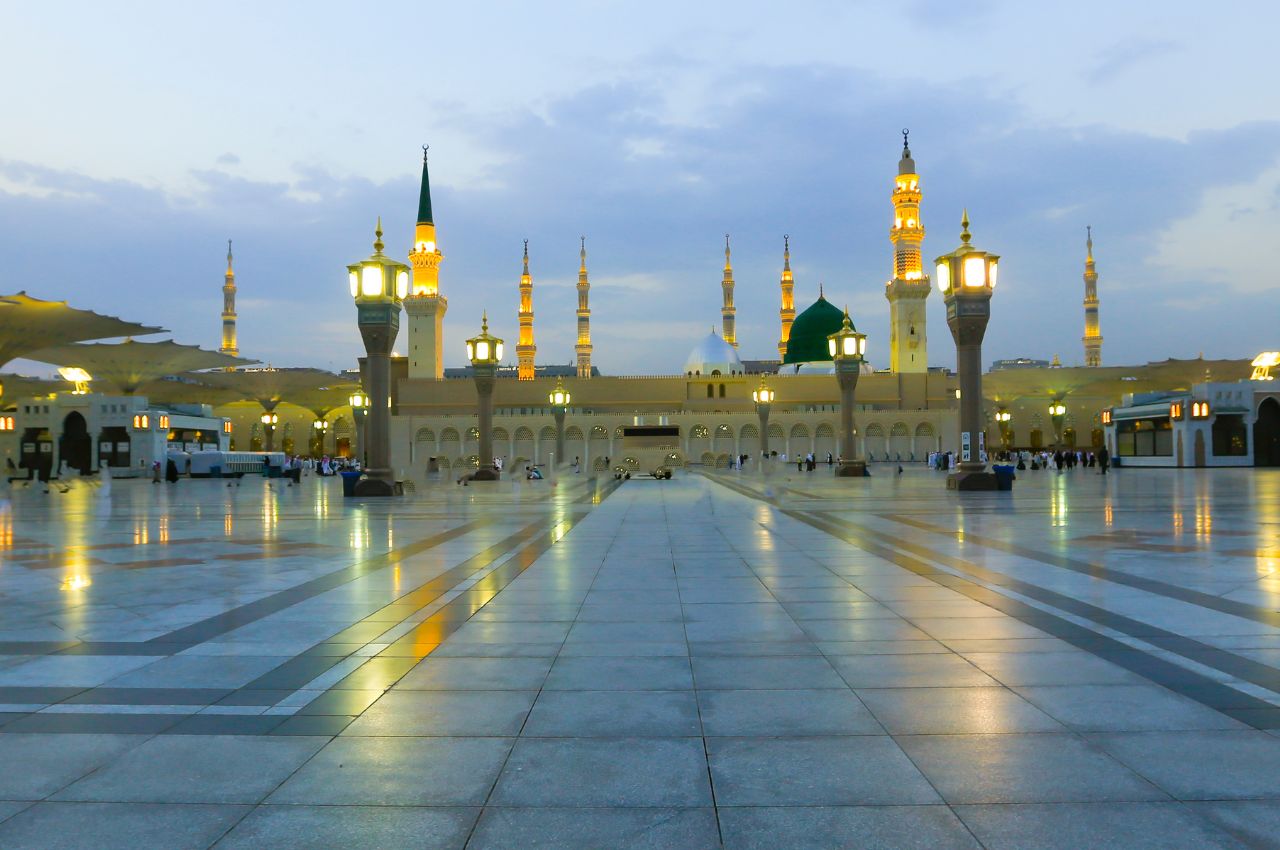
The mosque in Medina became the nucleus of the new Islamic order. It served not only as a place of worship but also as a center for political consultation, judicial arbitration, education, diplomacy, and administration. Delegations from tribes across Arabia were received there, treaties were negotiated, disputes were settled, and Qur’anic revelations were taught and memorized. The mosque therefore functioned simultaneously as a religious sanctuary, administrative institution, and intellectual center for the growing Muslim community.
Muhammad also laid the foundations for diplomatic and administrative organization beyond Medina. He dispatched emissaries, teachers, judges, and Qur’an reciters to different tribes and regions of Arabia. These representatives instructed new Muslim communities in religious practice, mediated disputes, and strengthened political relations with Medina. Following the Treaty of Hudaybiyyah in 628 CE, Muhammad expanded diplomatic contact beyond Arabia by sending letters and envoys to neighboring rulers, including the Byzantine emperor Heraclius, the Sassanian ruler Khosrow II, the Negus of Abyssinia, and regional Arab governors. Islamic historical sources present these exchanges as reflecting the emergence of Medina as an increasingly organized political center engaged in regional diplomacy.
Another important aspect of Muhammad’s statecraft was the establishment of written agreements regulating relations among diverse communities. The Constitution of Medina attempted to define relations between Muslims, Jewish tribes, and other groups within the city by establishing mutual obligations of defense, communal cooperation, and religious freedom. Although political tensions later emerged between Muhammad’s community and certain Jewish tribes, the document represented one of the earliest efforts in Arabia to create a broader political framework transcending tribal affiliation alone.
Muhammad’s leadership also emphasized ethical norms in governance and warfare. Islamic sources describe prohibitions against unnecessary destruction, mistreatment of noncombatants, and acts of vengeance that had long characterized tribal conflict. Following the peaceful conquest of Mecca in 630 CE, Muhammad declared a general amnesty for many of his former opponents rather than pursuing large-scale retaliation. This policy contributed to the consolidation of political authority while reducing the cycle of tribal revenge that had historically shaped Arabian society.
Through consultation, institution-building, diplomacy, legal agreements, and communal organization, Muhammad established many of the foundational principles later associated with Islamic governance. While the Islamic empires that emerged after his death developed more elaborate political institutions, many early Muslim scholars viewed the Medinan community under Muhammad as the original model of Islamic political and social order.
The Transformation of Arabia and the Rise of Medina
The emergence of Islam in seventh-century Arabia transformed not only the religious life of the region but also its political, social, and intellectual structures. Prior to Muhammad’s prophetic mission, Arabia was characterized by tribal fragmentation, shifting alliances, and recurring cycles of intertribal warfare. Loyalty was directed primarily toward kinship and tribal affiliation rather than toward broader political or religious institutions. Although Judaism and Christianity existed in parts of Arabia, the dominant religious culture of western and central Arabia remained largely polytheistic. Mecca nevertheless occupied an important position as a center of pilgrimage and commerce connected to regional trade routes extending toward Syria, Iraq, Yemen, and the Red Sea.
Muhammad’s message introduced a new basis for communal identity grounded in monotheism, moral accountability, and collective solidarity. The Qur’an repeatedly emphasized the unity of God and condemned tribal arrogance, social inequality, and idol worship. This message gradually attracted followers from different social backgrounds, including merchants, tribal notables, women, slaves, and poorer segments of Meccan society. Early converts included Khadija bint Khuwaylid, Ali ibn Abi Talib, Abu Bakr, Uthman ibn Affan, and Bilal ibn Rabah.
As opposition from Meccan leaders intensified, Muhammad encouraged some Muslims to seek refuge in Abyssinia under the protection of the Christian ruler known in Islamic sources as the Negus (Najashi). The migrations to Abyssinia in 615 and 616 CE represented the first organized attempts to preserve the emerging Muslim community outside Mecca. Islamic tradition portrays the Negus as a just ruler who refused demands from the Quraysh to extradite the Muslim migrants after hearing their defense and learning about Islamic teachings concerning Jesus and Mary.
The decisive turning point in the transformation of Arabia came with the Hijra (migration) from Mecca to Medina in 622 CE. Delegations from Medina had previously met Muhammad during pilgrimage seasons in Mecca and invited him to their city in the hope that he could mediate disputes between the rival tribes of al-Aws and al-Khazraj and help establish political stability. These meetings culminated in the Pledges of al-‘Aqabah, during which Medinan representatives pledged loyalty and protection to Muhammad and the Muslim community.
The Hijra marked the beginning of a new political and religious order centered in Medina. Upon his arrival, Muhammad established a mosque that functioned not only as a place of worship but also as the administrative, judicial, educational, and diplomatic center of the emerging Muslim community. Medina gradually became the seat of government of the new Islamic polity and the center from which Muhammad organized relations among tribes, directed military defense, dispatched emissaries, and administered communal affairs.
Muhammad also worked to integrate the Meccan migrants (Muhajirun) with their Medinan supporters (Ansar). Islamic sources emphasize that the Ansar shared homes, wealth, and commercial opportunities with the migrants from Mecca in an effort to establish social solidarity and reduce tribal divisions. Through these measures, Muhammad sought to replace older patterns of tribal rivalry with a broader sense of communal identity grounded in shared belief and mutual obligation.
An important aspect of this transformation was the drafting of agreements regulating relations among Muslims, Jewish tribes, and other communities within Medina. What later became known as the Constitution of Medina established mutual obligations of defense and attempted to create a framework for coexistence among the city’s diverse tribal and religious groups. Although political tensions later emerged between Muhammad’s community and certain Jewish tribes, particularly Banu Qaynuqa‘ and Banu Nadir, historians generally view these developments within the broader context of the fragile political and military environment surrounding Medina during this period.
Social Reform and the Ethical Transformation of Arabia
Among the most significant aspects of Muhammad’s mission was the attempt to reshape the social and moral foundations of Arabian society. Pre-Islamic Arabia was deeply tribal and hierarchical, with status often determined by lineage, tribal affiliation, wealth, gender, and social rank. Slavery was widespread, tribal loyalty frequently superseded broader ethical obligations, and women in many tribes possessed limited legal and social protections.
The Qur’anic message introduced ethical principles that challenged many of these prevailing social norms. The Qur’an emphasized the spiritual equality of believers and declared that human worth was determined not by tribal origin, ethnicity, or wealth, but by righteousness and moral conduct. One frequently cited verse states: “O mankind, We created you from a male and a female and made you peoples and tribes that you may know one another. Truly, the most honored of you in the sight of God is the most righteous among you.”
Muhammad’s community in Medina increasingly brought together individuals from different tribal, ethnic, and social backgrounds under a shared religious identity. Early converts included members of prominent Meccan families as well as slaves, the poor, and socially marginalized individuals. Bilal ibn Rabah, a formerly enslaved Abyssinian Muslim who became one of the earliest followers of Muhammad, later emerged as an important figure within the Muslim community and was chosen to deliver the call to prayer. Islamic tradition frequently presents such developments as evidence of Islam’s challenge to tribal and racial hierarchies.
Muhammad’s teachings also encouraged charitable obligations and social welfare. The Qur’an repeatedly emphasized care for the poor, orphans, widows, travelers, and enslaved persons. Charity (zakat) became one of the central obligations within the emerging Muslim community and contributed to the development of communal responsibility and social solidarity.
The status of women also underwent important changes during the early Islamic period.Although Arabian society varied considerably across tribes and regions, women in many settings faced social and economic vulnerabilities. The Qur’an prohibited female infanticide, recognized women’s rights to inheritance and property, regulated marriage and divorce, and emphasized mutual obligations between men and women. Muhammad’s first wife, Khadija bint Khuwaylid, herself a successful merchant, played a central role in supporting the early Muslim movement. Women also participated in religious life, transmitted knowledge, and in some cases accompanied the Muslim community during major political and military events.
While the social order that emerged in seventh-century Arabia remained shaped by many realities of its historical context, Muhammad’s teachings introduced ethical and legal reforms that sought to moderate tribal inequality, expand communal obligations, and establish a broader moral framework centered on justice, compassion, and accountability before God.
The military confrontations between Medina and Mecca further accelerated the transformation of Arabia. In 624 CE, the Muslims secured a significant victory at the Battle of Badr despite being greatly outnumbered by Meccan forces. The victory strengthened the political position of Medina and demonstrated the growing cohesion of the Muslim community. Although the Muslims later suffered setbacks at the Battle of Uhud in 625 CE, the survival of Medina reinforced Muhammad’s authority and the resilience of the emerging state.
The Battle of the Ditch (al-Khandaq) in 627 CE marked another turning point. Faced with a large coalition of Meccan and allied tribal forces, the Muslims adopted defensive strategies that ultimately prevented the fall of Medina. The failure of the siege weakened Meccan prestige and confirmed the political durability of the Medinan state.
Muhammad increasingly combined diplomacy with military organization in his efforts to stabilize Arabia. In 628 CE, negotiations between the Muslims and the Quraysh resulted in the Treaty of Hudaybiyyah, which established a temporary truce between Mecca and Medina. Although some Muslims initially viewed the treaty as a concession, historians generally regard it as a major diplomatic success that allowed the Muslim community to expand peacefully and strengthen alliances throughout Arabia.
In 630 CE, Muhammad entered Mecca with a large Muslim force after violations of the treaty by Meccan allies. The city surrendered with minimal resistance, and Islamic sources emphasize Muhammad’s declaration of a general amnesty for many former opponents. Idols within the Ka‘ba were removed, and the sanctuary was rededicated to the worship of one God. Despite the symbolic importance of Mecca, Muhammad retained Medina as the political and administrative center of the Islamic state.
During the final years of his life, Muhammad dispatched emissaries and letters to tribal leaders and neighboring rulers throughout and beyond Arabia inviting them to Islam and seeking diplomatic relations. According to early Muslim historians, letters were sent to rulers including Heraclius of the Byzantine Empire, Khosrow II of Persia, the Negus of Ethiopia, and regional Arab governors allied with the Byzantine and Sassanian empires. Tribal delegations increasingly traveled to Medina to negotiate alliances, learn about Islam, and establish relations with the emerging Muslim state.
By the time of Muhammad’s death in 632 CE, much of Arabia had entered into alliance with or accepted the authority of the Muslim community centered in Medina. Under Muhammad’s leadership, Medina evolved from a divided oasis town into the political, religious, and intellectual center of a rapidly expanding civilization. The city became the center of governance, diplomacy, legal development, religious learning, and communal organization whose influence extended far beyond Arabia after Muhammad’s death.
Conclusion
The rise of Islam under Muhammad marked one of the most significant transformations in the history of Arabia. Emerging from a fragmented tribal society characterized by recurring conflict, shifting alliances, and religious pluralism, Muhammad introduced a religious and political framework centered on monotheism, moral accountability, justice, and communal solidarity. His message challenged entrenched tribal divisions and gradually redirected loyalty from kinship structures toward membership in a broader religious community, the ummah.
Muhammad’s significance, however, extended beyond his role as a religious prophet. Through the Hijra to Medina and the subsequent formation of the Medinan state, he became a political leader, diplomat, military organizer, and institution builder. Under his leadership, Medina evolved into the administrative and intellectual center of the emerging Muslim community, where religious teachings, legal principles, political authority, and communal organization became increasingly interconnected. The mosque of Medina functioned not only as a place of worship but also as a center of governance, consultation, diplomacy, and learning.
The military and diplomatic struggles between Medina and Mecca further accelerated the transformation of Arabia. Victories such as Badr, the resilience demonstrated during al-Khandaq, and the diplomatic achievements of the Treaty of Hudaybiyyah strengthened the position of the Muslim community and expanded its influence throughout the peninsula. By the peaceful conquest of Mecca in 630 CE, Muhammad had succeeded in reshaping the religious and political order of Arabia while avoiding the large-scale vengeance that often characterized tribal warfare.
By the time of Muhammad’s death in 632 CE, much of Arabia had entered into alliance with or accepted the authority of the Medinan state. The transformation initiated during his lifetime continued under his successors and ultimately contributed to the emergence of a major world civilization that profoundly influenced the religious, intellectual, political, and cultural history of the Middle East and beyond. For Muslims, Muhammad remains the final prophet and messenger of God; for historians, he stands as one of the most consequential religious and political leaders in world history.