
Abstract
The Qur’an repeatedly invites reflection upon the natural world as a means of recognizing the signs embedded within creation. Among the phenomena highlighted in the Qur’anic text are the development of human life in the womb and the broader structure of the cosmos. This article examines the relationship between these two domains—human embryology and cosmic order—within the Qur’anic worldview. Through linguistic analysis, historical contextualization, and engagement with modern scientific perspectives, this study explores how the Qur’anic text describes stages of human development while simultaneously directing attention to the structure and temporality of the universe. The article situates Qur’anic descriptions of embryological development within the broader intellectual history of embryology, including classical Greek theories associated with Aristotle and Galen and their transmission into Islamic scientific traditions. It further examines the semantic range of key Arabic terms—nutfah, ʿalaqah, and mudghah—as preserved in classical Arabic lexicons and Qur’anic exegesis. The study then considers modern embryological knowledge and evaluates areas of convergence and debate between contemporary scientific understanding and Qur’anic descriptions. Finally, the article expands the discussion to include Qur’anic cosmology and conceptions of cosmic time, demonstrating how the Qur’anic text situates human creation within a larger framework of cosmic order. By linking the microcosm of human development with the macrocosm of the universe, this study argues that the Qur’anic text articulates a coherent vision of creation that encourages reflection upon both biological processes and the structure of the cosmos.
Introduction
The Qur’anic text repeatedly calls upon human beings to reflect upon the processes of creation and the natural world. Rather than presenting the universe as an inscrutable mystery, the Qur’anic text consistently directs attention to observable phenomena as signs (āyāt) that invite contemplation and encourage investigation and intellectual inquiry. This invitation to reflection constitutes an important epistemological principle within the Qur’anic worldview: knowledge of creation emerges through careful observation and thoughtful reflection upon the natural order.
One Qur’anic verse emphasizes this reflective orientation by asking:
“Do they not reflect within themselves? God did not create the heavens and the earth and what is between them except in truth and for a specified term.” (Qur’an 30:8)
This verse suggests that the created order possesses coherence, intelligibility, and purpose. The universe is not portrayed as a chaotic or arbitrary system but rather as a structured reality governed by principles that invite reflection. Within this framework, the study of natural phenomena—including biological development and cosmic structure—can be understood as a legitimate domain of intellectual inquiry.
The Qur’anic text further expands this invitation to reflection by directing attention simultaneously to the macrocosm of the universe and the microcosm of human existence. In another passage, the text states:
“We will show them Our signs in the horizons and within themselves until it becomes clear to them that it is the truth.” (Qur’an 41:53)
This verse establishes a conceptual link between the investigation of the external universe (al-āfāq) and the examination of the human self (anfusihim). Both realms are presented as sites in which the signs of creation become manifest. The study of the cosmos and the study of human life are therefore interconnected forms of reflection within the Qur’anic intellectual framework.
Similarly, the Qur’an praises those who contemplate the structure of the universe:
“They reflect upon the creation of the heavens and the earth, saying: Our Lord, You have not created this in vain.” (Qur’an 3:191)
Taken together, these passages articulate a vision in which reflection upon creation is both an intellectual and a spiritual endeavor. The natural world is presented as a domain of meaningful signs that invite investigation rather than passive acceptance.
Within this broader framework, the Qur’an refers repeatedly to the development of human life in the womb. Several passages describe stages through which the embryo develops, using terms such as nutfah (a drop), ʿalaqah (a clinging form), and mudghah (a chewed-like lump). These descriptions have long attracted the attention of commentators and scholars seeking to understand their linguistic, theological, and biological implications.
At the same time, the Qur’an situates the creation of human beings within a much larger cosmic context. Numerous passages refer to the structure of the heavens, the order of celestial bodies, and the passage of cosmic time. This broader cosmological perspective suggests that the development of human life represents one component of a larger system of creation governed by order and purpose.
The present study explores the relationship between these two domains—human embryological development and cosmic structure—within the Qur’anic worldview. By examining Qur’anic descriptions of embryological stages alongside references to the structure and temporality of the universe, the article seeks to illuminate how the Qur’anic text articulates a unified vision of creation that encompasses both biological and cosmic processes.
Methodologically, this study employs a textual and historical approach that combines linguistic analysis of Qur’anic terminology, examination of classical exegetical literature, and engagement with the intellectual history of embryology and cosmology. Rather than treating the Qur’an as a scientific manual—which it is not—this analysis approaches the text as a source of philosophical reflection on the natural world, examining how its language encourages contemplation of biological development and cosmic structure within broader historical and intellectual contexts.
To accomplish this goal, the article adopts an interdisciplinary approach that combines several analytical perspectives. First, it situates Qur’anic references to embryological development within the broader historical context of embryological thought, including the classical theories proposed by figures such as Aristotle and Galen. Second, it examines the linguistic dimensions of key Qur’anic terminology through reference to classical Arabic lexicons and exegetical traditions. Third, it considers how modern embryology has interpreted the stages of human development and evaluates areas of convergence and debate between contemporary scientific knowledge and Qur’anic narratives.
By examining Qur’anic descriptions of embryological development alongside references to the structure and temporality of the universe, this article explores how the Qur’anic text articulates a unified vision of creation in which the microcosm of human life and the macrocosm of the cosmos function as complementary domains of reflection. Within this framework, the processes of biological development and cosmic formation are presented not as isolated phenomena but as interconnected signs (āyāt) that invite human beings to contemplate the coherence and intelligibility of the created order.
The discussion proceeds in several stages. First, the article examines the Qur’anic epistemological framework that encourages reflection upon natural phenomena as signs of creation. It then reviews the historical development of embryological thought in order to situate Qur’anic descriptions of human development within the broader intellectual history of biological inquiry. The analysis subsequently turns to the Qur’anic portrayal of the cosmos, exploring themes of order, motion, cosmic origins, and cosmic time. By bringing these two domains—human development and cosmic structure—into dialogue, the article argues that the Qur’an presents a unified vision in which the microcosm of human life and the macrocosm of the universe together reveal the intelligible order of creation.
1. Qur’anic Epistemology and the Observation of Nature
A distinctive feature of the Qur’anic worldview is its encouragement of reflection upon the natural world as a means of acquiring knowledge. Rather than portraying nature as separate from revelation, the Qur’an frequently describes natural phenomena as āyāt (signs) that point toward deeper truths concerning the structure and origin of existence. Human beings are repeatedly invited to observe the processes of the world around them and to recognize within them patterns of order, balance, and purpose.
The Qur’anic text directs attention to a wide range of natural phenomena, including the development of living beings, the cycles of the earth, and the structure of the heavens. In one verse, the text declares: “We will show them Our signs in the horizons and within themselves until it becomes clear to them that it is the truth” (Qur’an 41:53). This formulation establishes a conceptual link between the external universe (al-āfāq) and the inner dimensions of human existence (anfusihim). Both realms function as sites in which the signs of creation become manifest.
Modern discussions of science and religion have also examined how religious traditions conceptualize the intelligibility of the natural world. The historian of science Ian Barbour has argued that many religious cosmologies provide conceptual frameworks that encourage the systematic study of nature by portraying the universe as orderly and intelligible rather than chaotic or arbitrary. Similarly, contemporary scholars of Islamic thought have explored how Qur’anic descriptions of creation shaped intellectual attitudes toward the study of nature within Muslim societies. The physicist and philosopher of science Nidhal Guessoum has emphasized that the Qur’an’s repeated references to natural phenomena—ranging from the movements of celestial bodies to the development of human life—encourage a reflective engagement with the natural world that is compatible with empirical inquiry. In a similar vein, the Iranian philosopher of science Mehdi Golshani has argued that Islamic intellectual traditions historically understood scientific investigation as part of a broader search for knowledge concerning the order and intelligibility of creation. These perspectives highlight the broader epistemological context within which Qur’anic discussions of natural phenomena can be understood: not as technical scientific statements, but as invitations to contemplate the structured and intelligible character of the natural world.
Within this epistemological framework, the observation of nature becomes a legitimate form of intellectual inquiry. The processes of the natural world are presented not as arbitrary events but as manifestations of an intelligible order that invites reflection. The Qur’anic references to embryological development and cosmic structure examined in this article can therefore be understood as part of a broader invitation to contemplate the signs embedded within creation.
The epistemological orientation reflected in these passages also helped shape the intellectual environment in which scientific inquiry developed in classical Islamic civilization. Scholars working in fields such as astronomy, medicine, and optics often regarded the study of nature as a means of exploring the signs embedded within creation. Figures such as Ibn al-Haytham, whose work on optics emphasized systematic observation and experimentation, and Ibn Sina, whose writings on medicine and natural philosophy influenced scientific traditions across the medieval world, exemplified an intellectual approach that combined philosophical reflection with empirical investigation. Similarly, the great polymath Al-Biruni conducted remarkably precise studies of astronomy, geography, and the natural sciences, often emphasizing careful measurement and critical analysis. Although these scholars worked within diverse philosophical frameworks, their investigations were frequently understood as part of a broader effort to understand the ordered structure of the natural world. The Qur’anic encouragement to observe the phenomena of the heavens and the earth therefore resonated with a wider intellectual culture in which the study of nature was seen not merely as practical knowledge but as a pathway to deeper reflection upon the coherence and intelligibility of creation.
2. Historical Development of Embryology
Early discussions of embryological development appear in Greek medical and philosophical traditions. Writers associated with the Hippocratic corpus described human development as the gradual formation of the embryo from reproductive fluids, emphasizing processes of growth and differentiation within the womb. Aristotle later expanded these discussions, proposing that embryological development unfolds through successive stages in which form gradually emerges from initially undifferentiated matter.
Although these early theories represented important attempts to explain biological development, they were based largely on philosophical reasoning and limited anatomical observation. Qur’anic descriptions of human formation differ in style and purpose, presenting concise references to recognizable stages of development while directing attention toward the signs embedded within the process of creation.
Aristotle’s biological works represent one of the earliest systematic efforts to develop a coherent theory of reproduction and embryological development. In his treatise Generation of Animals, he proposed that the embryo develops gradually from an initially undifferentiated state through a process later described as epigenesis. According to this theory, the embryo does not exist in miniature form from the outset but instead develops progressively as different structures and organs emerge over time.
Aristotle also advanced a theory of reproduction in which the male and female contributions play distinct roles. In his view, the male semen provides the active principle responsible for organizing development, while the female contributes the material substrate from which the embryo is formed. Although Aristotle recognized that development occurs in stages, his understanding of embryological processes was constrained by the absence of microscopic observation and detailed anatomical knowledge.
Despite these limitations, Aristotelian embryology exerted a profound influence on later intellectual traditions. For centuries, his writings shaped the understanding of biological development in both the Greek and Islamic worlds, as well as in medieval European scholarship.
Several centuries after Aristotle, the physician Galen developed a more elaborate medical theory of embryological development. Galen’s writings synthesized earlier Greek knowledge with his own anatomical observations and became authoritative throughout much of late antiquity and the medieval period.
Galen proposed that embryological development proceeds through a series of stages beginning with the mixture of reproductive fluids, followed by the formation of a blood-like substance, and eventually the differentiation of flesh and organs. His account represented an attempt to reconcile philosophical theories of generation with empirical observations drawn from animal anatomy. Although Galen’s framework introduced greater anatomical detail than earlier models, it remained limited by the absence of experimental and microscopic methods.
The transmission of Greek medical knowledge into the Islamic world during the early Abbasid period played a crucial role in the development of medical and biological sciences. Works by Aristotle and Galen were translated into Arabic and studied extensively by physicians and philosophers. These translations were not merely preserved but critically examined and expanded upon by later scholars.
Medical writers such as Ibn Sina integrated earlier Greek theories into broader medical systems that emphasized observation and clinical experience. In his monumental encyclopedia The Canon of Medicine, Ibn Sīnā discussed stages of fetal development while synthesizing Aristotelian biology with empirical medical knowledge. Although medieval physicians lacked the tools necessary to observe embryonic development at the microscopic level, their writings reflect a sustained effort to understand the processes through which human life forms and develops.
The development of modern embryology accelerated significantly during the seventeenth and eighteenth centuries, particularly with the introduction of the microscope. Advances in microscopy allowed scientists to observe early developmental stages with increasing accuracy, leading to the gradual refinement of biological theories of reproduction and development.
An important milestone in this transformation occurred with the work of the English physician William Harvey, whose research challenged earlier assumptions about the origin of life. Harvey emphasized observation and experimentation, famously asserting that all living beings arise from eggs (ex ovo omnia). His work marked a decisive shift from speculative theories toward empirical biological investigation.
Subsequent developments in the nineteenth and twentieth centuries further clarified the processes underlying human development. Advances in cellular biology, genetics, and developmental biology revealed the complex mechanisms governing the formation of tissues and organs. Modern embryology now describes human development as a highly coordinated sequence of cellular differentiation, growth, and morphological transformation.
Within this broader historical context, Qur’anic descriptions of embryological development have attracted considerable scholarly attention. Some researchers have sought to compare Qur’anic terminology with modern scientific knowledge, while others have emphasized the linguistic and exegetical dimensions of the text. In either case, situating Qur’anic references within the longer intellectual history of embryological thought provides an essential framework for understanding their meaning and significance.
3. Greek Embryology and the Qur’anic Description
A comparison between classical Greek embryological theories and Qur’anic descriptions of human development offers valuable insight into the intellectual context of premodern discussions of generation and reproduction. While Greek philosophers and physicians sought to construct explanatory models of biological development, the Qur’anic text presents a concise sequence of descriptive stages through which human life emerges in the womb.
As noted above, the embryological theories proposed by Aristotle and later elaborated by Galen formed the foundation of premodern medical thought. Aristotle’s theory of epigenesis held that the embryo develops gradually from an initially undifferentiated state, with form emerging progressively over time. Galen expanded this framework by proposing a staged process beginning with the mixture of reproductive fluids, followed by the formation of a blood-like substance and the eventual differentiation of organs.
Although these theories represented significant early efforts to understand biological development, they remained largely speculative and were constrained by the limitations of premodern observational methods. In contrast, Qur’anic references to human development do not attempt to construct a biological theory of reproduction. Rather, the text employs concise and evocative language to describe successive stages in embryonic formation.
One of the most frequently cited passages appears in the following verse:
“We created the human being from a drop (nutfah), then We made the drop into a clinging form (‘alaqah), then We made the clinging form into a chewed-like lump (mudghah)” (Qur’an 23:14).
This verse presents a sequence of transformations without elaborating the underlying biological mechanisms. Instead, it describes observable morphological stages through terminology drawn from the semantic range of classical Arabic.
The term nutfah denotes a minute drop of fluid associated with reproduction. The term ‘alaqah, derived from a root meaning “to cling” or “to attach,” has been interpreted by classical commentators as referring to a stage in which the developing entity adheres within the womb. The term mudghah refers to a small piece of flesh resembling something chewed, evoking an image of an irregular, developing mass.
Classical exegetes such as al-Ṭabarī and Ibn Kathīr interpreted these expressions as describing successive stages in embryonic development. Their analyses were grounded primarily in linguistic interpretation and transmitted reports rather than empirical biological investigation, reflecting the epistemological framework of early Qur’anic exegesis.
When compared with Greek embryological theories, the Qur’anic description reveals a notable methodological distinction. Greek authors sought to explain development through theoretical models rooted in metaphysical assumptions about matter, form, and causation. The Qur’anic text, by contrast, adopts a descriptive mode that emphasizes recognizable stages without advancing a causal or mechanistic account.
This distinction is crucial for proper interpretation. The Qur’an does not present itself as a scientific treatise but as a text that directs attention to the signs (āyāt) embedded within natural processes. Its references to embryological development function primarily as prompts for reflection on the complexity and ordered nature of human creation.
From a contemporary scholarly perspective, comparisons between Qur’anic descriptions and modern embryology must therefore be approached with methodological caution. While certain terms may appear to correspond to observable developmental stages, the primary purpose of these passages is not explanatory but contemplative.
Nevertheless, the structured sequence of stages presented in Qur’anic discourse has continued to attract scholarly interest, particularly in discussions concerning the relationship between scriptural language and scientific knowledge. This interest becomes especially significant when these embryological descriptions are considered alongside the broader cosmological framework of the Qur’an, in which both human development and the structure of the universe are presented as manifestations of an underlying order. This comparison underscores the importance of approaching Qur’anic descriptions through their linguistic and semantic dimensions, a task to which the following section now turns.
4. Linguistic Analysis of Qur’anic Terminology
A careful understanding of Qur’anic descriptions of human development requires close attention to the linguistic and semantic dimensions of the key Arabic terms used in the text. The Qur’anic vocabulary describing embryological development is concise yet semantically rich, most notably in the terms nutfah, ‘alaqah, and mudghah. These expressions carry layered meanings within classical Arabic and have been the subject of sustained analysis in both lexicographical works and Qur’anic exegesis.
The interpretation of these terms has traditionally relied upon authoritative Arabic lexicons and early linguistic scholarship. Foundational sources include Lisān al-ʿArab by Ibn Manẓūr and Tāj al-ʿArūs by al-Zabīdī, as well as semantic works such as Mufradāt Alfāẓ al-Qurʾān by al-Rāghib al-Iṣfahānī. These texts preserve the semantic range of classical Arabic vocabulary and provide essential insight into how early scholars understood Qur’anic terminology.
The Term Nutfah
The first stage of human development mentioned in several Qur’anic passages is described by the term nutfah. In classical Arabic usage, the word denotes a small quantity or drop of liquid, frequently associated with the reproductive substance from which human life originates. Lexicographical discussions emphasize its meaning as a minute, almost insignificant fluid element, thereby underscoring the humble biological origin of human beings.
The Qur’anic use of this term highlights the transformation of a minute drop into a complex living organism. This linguistic framing reinforces a broader thematic emphasis on the processes of creation, in which life emerges through ordered stages from seemingly simple beginnings. Classical exegetes such as al-Ṭabarī interpret nutfah as the initial generative substance from which embryonic development proceeds.
The Term ‘Alaqah
The second stage is expressed through the term ‘alaqah, derived from the root ʿ-l-q, which conveys meanings of attachment, clinging, or suspension. Classical Arabic sources also associate the term with related meanings such as a leech-like form or a clot of blood.
In his semantic analysis, al-Rāghib al-Iṣfahānī emphasizes the core meaning of adhesion or attachment, interpreting ‘alaqah as something that clings to another entity. This interpretation informed classical exegetical readings, in which the term was understood as describing a stage in which the developing embryo becomes attached within the womb.
Exegetes such as Ibn Kathīr describe this stage as a small clot-like form adhering within the uterine environment. The imagery conveyed by the term is therefore morphological and descriptive rather than technical, reflecting the broader linguistic style of the Qur’anic text.
The Term Mudghah
The third stage of development is described using the term mudghah, which in classical Arabic refers to a small piece of flesh resembling something that has been chewed. The term evokes the image of an irregular mass bearing indentations analogous to the marks left by chewing.
Lexicographers such as al-Zabīdī explain that mudghah denotes a morsel of flesh small enough to be chewed in the mouth. The Qur’anic usage of the term thus provides a vivid visual representation of the developing embryo at a particular stage of formation.
Commentators including al-Qurṭubī interpret this stage as a subsequent phase following the ‘alaqah, in which the embryo assumes a more defined physical structure while still retaining an undeveloped and irregular form.
5. Descriptive Language and Semantic Methodology
The analysis of these three terms highlights a central characteristic of Qur’anic language: its reliance on descriptive imagery rooted in everyday vocabulary rather than technical or specialized terminology. The Qur’anic text does not attempt to construct a biological taxonomy of embryological processes; instead, it employs accessible linguistic forms to evoke recognizable stages of development.
From a methodological perspective, this observation is critical. Interpreting Qur’anic terminology requires situating these terms within their classical linguistic context rather than retroactively imposing modern scientific categories upon them. Classical lexicons and early exegetical works therefore remain indispensable tools for understanding the semantic scope of these expressions.
At the same time, the precision and consistency of this terminology have invited continued scholarly reflection, particularly in discussions concerning the relationship between scriptural language and scientific knowledge. While such comparisons must be approached cautiously, the semantic richness of Qur’anic vocabulary continues to provide a productive basis for interdisciplinary inquiry.
This linguistic analysis also serves as a conceptual bridge to the broader themes of the present study. The staged development of the human embryo, articulated through concise and vivid terminology, reflects patterns of order and transformation that the Qur’anic text likewise attributes to the structure of the cosmos. The transition from embryology to cosmology thus represents not a shift in subject matter but an expansion in scale—from the microcosm of human formation to the macrocosm of the universe.
Semantic Imagery and Descriptive Language
The linguistic analysis of the terms nutfah, ‘alaqah, and mudghah highlights a central feature of Qur’anic discourse: its reliance on descriptive imagery rooted in everyday language. Rather than presenting a technical or systematic account of embryological processes, the Qur’anic text employs a vocabulary that evokes recognizable forms and transformations, allowing complex phenomena to be conveyed through concise and accessible expressions.
This descriptive strategy enables the communication of developmental processes without recourse to specialized terminology. The three terms collectively portray a sequence of morphological transformations through which human life emerges, emphasizing continuity, progression, and transformation rather than mechanistic explanation. In this respect, the Qur’anic mode of description differs fundamentally from scientific discourse, which seeks to explain causal mechanisms through analytical models.
From a methodological perspective, this distinction is essential. Interpreting Qur’anic terminology requires situating these expressions within their classical linguistic and semantic context. Reliance on authoritative lexicons—such as those of Ibn Manẓūr and al-Zabīdī—as well as early exegetical traditions, helps prevent anachronistic readings that project modern scientific categories onto premodern texts. Such an approach preserves the integrity of the Qur’anic discourse while allowing for historically grounded interpretation.
At the same time, the semantic richness and internal coherence of this vocabulary have led modern scholars to explore potential points of comparison between Qur’anic descriptions and contemporary embryological knowledge. These comparative efforts, while often illuminating, must be approached with caution. As scholars such as Nidhal Guessoum have emphasized, scriptural language operates within a distinct epistemological framework and should not be reduced to scientific description.
Beyond its linguistic and methodological implications, this analysis raises a broader conceptual question concerning the place of human life within the larger order of creation. The Qur’anic text does not present embryological development as an isolated biological phenomenon; rather, it situates it within a wider framework of cosmic structure and meaning. The staged development of the embryo—articulated through images of transformation and proportion—reflects patterns that the Qur’anic text also attributes to the structure of the universe.
In this sense, the movement from embryology to cosmology represents not a shift in subject matter but an expansion in scale. The microcosm of human formation and the macrocosm of the universe are presented as parallel domains in which similar principles—order, proportion, and transformation—are manifested. This conceptual continuity prepares the transition to Qur’anic cosmology, where the same themes reappear in descriptions of the heavens, celestial motion, and the structure of the cosmos.
The reflections on embryological development examined in the preceding sections thus serve a broader purpose within the Qur’anic discourse. They establish a pattern of ordered transformation that extends beyond the human body to encompass the universe as a whole. The following sections therefore turn to the macrocosmic dimension of creation, examining how Qur’anic descriptions of cosmic structure articulate a vision of the universe as a dynamic, ordered, and intelligible system.
6. Qur’anic Cosmology: Order, Structure, and the Dynamics of Creation
The Qur’anic text repeatedly invites reflection on the natural world as a means of discerning the order and wisdom underlying creation. While the earlier sections examined the formation of human life within the womb, the text also directs attention outward toward the structure of the universe. Human creation and cosmic creation are thus presented as complementary domains in which the signs (āyāt) of God become manifest.
A foundational concept in Qur’anic cosmology is that creation unfolds according to precise measure and proportion. The Qur’an states:
إِنَّا كُلَّ شَيْءٍ خَلَقْنَاهُ بِقَدَرٍ
“Indeed, We created everything according to a measure” (Qur’an 54:49).
The Arabic term qadar denotes determination, proportion, and exact measure. Creation is therefore not portrayed as arbitrary but as structured according to an underlying order governing the natural world. Classical exegetes emphasized that this measure reflects a comprehensive system in which all things are determined according to divine wisdom.
A similar idea appears in another verse:
وَخَلَقَ كُلَّ شَيْءٍ فَقَدَّرَهُ تَقْدِيرًا
“He created everything and determined it with precise determination” (Qur’an 25:2).
This formulation reinforces the concept that creation is governed not only by existence but by proportion and calibration. Fakhr al-Dīn al-Rāzī interprets such passages as indicating that every element within creation occupies a specific place within a larger structured whole.
The Qur’an further challenges the observer to search for inconsistency within the cosmos:
“You do not see in the creation of the Most Merciful any inconsistency. Return your vision again—do you see any flaw?” (Qur’an 67:3).
This verse presents the cosmos as internally coherent and free from contradiction. Al-Qurṭubī emphasizes that the absence of disparity in the heavens reflects the perfection and harmony of divine creation.
This emphasis on measure and coherence is reinforced by the assertion that nothing escapes divine knowledge:
لَا يَعْزُبُ عَنْهُ مِثْقَالُ ذَرَّةٍ فِي السَّمَاوَاتِ وَلَا فِي الْأَرْضِ
“Not even the weight of an atom in the heavens or the earth escapes Him…” (Qur’an 34:3).
Taken together, these passages present the cosmos as a system governed by balance, proportion, and intelligibility.
Modern cosmology similarly portrays the universe as governed by ordered laws and measurable structure. Contemporary astrophysical research describes the cosmos as evolving through mathematically describable processes governed by gravitational interaction and fundamental physical constants. Observations of cosmic background radiation, large-scale galactic distribution, and stellar evolution reveal a universe structured by regularities that enable scientists to reconstruct its history across billions of years. These dynamics are further reflected in introductory cosmological models describing large-scale structure and expansion.
Historians of science have further noted that the Qur’anic encouragement to reflect upon the natural world contributed to the development of scientific inquiry in the classical Islamic world. George Saliba argues that Islamic scientific traditions developed within an intellectual framework that treated the study of nature as a meaningful form of inquiry into the order of creation. Similarly, A. I. Sabra demonstrates how Greek scientific traditions were critically appropriated and transformed within medieval Islamic scholarship, contributing to the emergence of systematic scientific investigation.
7. The Earth as Habitable Order: Creation, Sustenance, and Human Orientation
In addition to describing the structure and measure of the cosmos, the Qur’anic text directs attention to the earth as a domain specifically ordered for human habitation. While the heavens reflect vastness, motion, and scale, the earth is portrayed as a stabilized environment in which life is sustained and meaningfully experienced.
One of the most frequently cited verses states:
﴿الَّذِي جَعَلَ لَكُمُ الْأَرْضَ فِرَاشًا وَالسَّمَاءَ بِنَاءً وَأَنْزَلَ مِنَ السَّمَاءِ مَاءً فَأَخْرَجَ بِهِ مِنَ الثَّمَرَاتِ رِزْقًا لَكُمْ﴾
“He is the One who made the earth a resting place for you and the sky a structure, and sent down water from the sky, thereby bringing forth fruits as provision for you.” (Qur’an 2:22)
The term firāsh (resting place or spread) conveys the idea of the earth as a surface made suitable for human life—stable, accessible, and supportive. Classical exegetes emphasized this dimension of habitability. Al-Tabari interprets the verse as indicating that the earth has been made manageable and conducive to settlement, while Al-Qurtubi highlights its suitability for cultivation, dwelling, and movement.
A related verse expands this perspective by situating the creation of the earth within a broader cosmological sequence:
﴿هُوَ الَّذِي خَلَقَ لَكُمْ مَا فِي الْأَرْضِ جَمِيعًا ثُمَّ اسْتَوَى إِلَى السَّمَاءِ فَسَوَّاهُنَّ سَبْعَ سَمَاوَاتٍ﴾
“He is the One who created for you all that is in the earth; then He turned to the heaven and fashioned them into seven heavens.” (Qur’an 2:29)
Here, the earth is presented as the immediate sphere of human existence, containing resources and conditions necessary for life. Classical commentators understood the phrase “created for you” (khalaqa lakum) as indicating that the natural world is ordered in a way that supports human existence and activity.
The Qur’anic discourse further emphasizes the dynamic processes through which life is sustained on earth:
﴿وَمَا أَنزَلَ اللَّهُ مِنَ السَّمَاءِ مِن مَّاءٍ فَأَحْيَا بِهِ الْأَرْضَ بَعْدَ مَوْتِهَا﴾
“And what God sends down from the sky of water, thereby reviving the earth after its death.” (Qur’an 2:164)
This recurring imagery of revival through rainfall reflects an observable ecological cycle. Classical exegetes interpreted such passages as signs of both physical sustenance and metaphysical renewal. From a contemporary scientific perspective, the hydrological cycle plays a fundamental role in sustaining ecosystems, regulating climate, and enabling agriculture (Lenton et al. 2008, 102–115).
The Qur’anic text also situates human existence within the earthly domain as part of a broader moral and existential framework:
﴿وَلَكُمْ فِي الْأَرْضِ مُسْتَقَرٌّ وَمَتَاعٌ إِلَىٰ حِينٍ﴾
“And for you upon the earth is a place of settlement and provision for a time.” (Qur’an 2:36)
This verse underscores the temporality of human life on earth. The earth is not merely a physical environment but also a stage for human action, responsibility, and moral testing. Classical commentators noted that the term mustaqarr (place of settlement) conveys both stability and temporariness, reflecting the dual nature of human existence as both grounded and transient.
Another passage highlights the diversity and complexity of natural phenomena associated with the earth:
﴿وَبَثَّ فِيهَا مِن كُلِّ دَابَّةٍ وَتَصْرِيفِ الرِّيَاحِ وَالسَّحَابِ الْمُسَخَّرِ﴾
“And He dispersed therein every kind of living creature, and the directing of the winds and the clouds controlled between the sky and the earth.” (Qur’an 2:164)
This verse brings together multiple elements—biological diversity, atmospheric dynamics, and climatic processes—into a unified depiction of the natural world. Modern Earth system science similarly emphasizes the interconnectedness of atmospheric, biological, and geological systems in sustaining life on the planet.
The Qur’anic text further reinforces the idea that creation is not without purpose:
﴿وَمَا خَلَقْنَا السَّمَاءَ وَالْأَرْضَ وَمَا بَيْنَهُمَا لَاعِبِينَ﴾
“We did not create the heavens and the earth and what is between them in play.” (Qur’an 21:16)
Classical exegetes consistently interpreted such verses as affirming that creation is grounded in truth (ḥaqq) and wisdom rather than randomness. This perspective aligns with the broader Qur’anic emphasis on intelligibility and order within the natural world.
Finally, the Qur’an draws attention to the relative scale of creation:
﴿لَخَلْقُ السَّمَاوَاتِ وَالْأَرْضِ أَكْبَرُ مِنْ خَلْقِ النَّاسِ﴾
“The creation of the heavens and the earth is greater than the creation of humankind.” (Qur’an 40:57)
This statement situates human existence within a vast cosmic framework while simultaneously inviting reflection on the relationship between the human and the universal.
Taken together, these passages portray the earth not merely as a physical object within the cosmos but as a carefully ordered environment in which multiple systems—ecological, atmospheric, and biological—operate in balance. The earth is both a site of sustenance and a locus of meaning, linking the physical processes of nature with the existential dimensions of human life.
This portrayal complements the broader Qur’anic cosmological vision outlined in the previous section. If the cosmos reflects order through measure, proportion, and motion, the earth represents that order as it is experienced directly within human life. The transition from the earth to the heavens in the following section therefore reflects a shift not in theme, but in scale—from the immediate environment of human existence to the wider dynamics of the universe.
8. Celestial Motion and the Dynamics of the Universe
The Qur’anic text consistently portrays the heavens not as a static structure but as a domain characterized by continuous motion governed by order and regularity. This emphasis on movement appears in several passages that describe celestial bodies as following defined courses within the cosmos.
A foundational verse states:
﴿وَهُوَ الَّذِي خَلَقَ اللَّيْلَ وَالنَّهَارَ وَالشَّمْسَ وَالْقَمَرَ كُلٌّ فِي فَلَكٍ يَسْبَحُون﴾
“It is He who created the night and the day, and the sun and the moon; each is swimming in an orbit.” (Qur’an 21:33)
The key terms in this verse are falak and yasbaḥūn. The word falak in classical Arabic denotes a rounded or curved path, often understood by early lexicographers as a celestial track or sphere. The verb yasbaḥūn (from the root s-b-ḥ) literally means “to swim” or “to move smoothly through a medium.” Together, these expressions convey the image of celestial bodies moving in continuous, flowing motion within defined trajectories.
Classical exegetes paid close attention to this imagery. Ibn Kathir interpreted the verse as indicating that the sun, moon, and other celestial bodies move along prescribed paths that do not deviate from their appointed courses. Similarly, Al-Qurtubi emphasized that each celestial body operates within a specific orbit (falak) established by divine order, highlighting the regularity and predictability of cosmic motion.
Another verse reinforces this dynamic portrayal:
﴿وَالشَّمْسُ تَجْرِي لِمُسْتَقَرٍّ لَّهَا﴾
“And the sun runs toward its appointed resting place.” (Qur’an 36:38)
The verb tajrī (“runs” or “flows”) further underscores motion as a defining characteristic of the heavens. Classical commentators differed in interpreting the phrase mustaqarr lahā. Some understood it as referring to a fixed endpoint or limit determined by divine decree, while others interpreted it as indicating a continuous course within an ordered system. In both readings, the emphasis remains on motion governed by structure rather than randomness.
The Qur’anic description of celestial motion is thus not merely observational but conceptual: it presents the cosmos as a system in which movement occurs within boundaries defined by order and proportion. This theme is reinforced elsewhere in the Qur’an:
﴿لَا الشَّمْسُ يَنبَغِي لَهَا أَن تُدْرِكَ الْقَمَرَ وَلَا اللَّيْلُ سَابِقُ النَّهَارِ وَكُلٌّ فِي فَلَكٍ يَسْبَحُون﴾
“It is not for the sun to overtake the moon, nor does the night outstrip the day; each is swimming in an orbit.” (Qur’an 36:40)
Here, the regularity of celestial motion is linked explicitly to balance and non-interference. The movements of cosmic bodies are coordinated in such a way that their respective functions remain distinct, reflecting a broader principle of harmony within the universe.
From the perspective of classical Islamic thought, such passages were understood as evidence of a cosmos governed by precise order. Exegetes frequently emphasized that the regularity of celestial motion points to an underlying system in which each element occupies a defined role. This interpretive tradition highlights not only motion but also the stability that arises from structured movement.
Modern astronomy likewise describes the universe as a dynamic system governed by mathematically expressible laws of motion and gravitational interaction. The motion of celestial bodies—from planetary orbits to galactic rotation—is understood in terms of gravitational forces, inertia, and spacetime geometry. At larger scales, galaxies themselves participate in complex patterns of motion, including rotation, clustering, and large-scale flow across the observable universe. These motions are not random but exhibit regularities that allow scientists to construct coherent models of cosmic evolution.
At the largest scales, galaxies themselves are not stationary but participate in complex patterns of motion, including rotation, clustering, and large-scale flow across the observable universe. These motions are not arbitrary but exhibit regularities that allow scientists to construct models of cosmic evolution.
It is important, however, to maintain methodological clarity. The Qur’anic text does not aim to provide a physical explanation of celestial mechanics. It does not describe gravitational forces, orbital equations, or astrophysical processes in technical terms. Rather, it draws attention to the observable fact of ordered motion and presents it as a sign (āyah) of the coherence of creation.
In this sense, the Qur’anic depiction of celestial motion operates at a different level of discourse than modern scientific cosmology. While science seeks to explain how celestial bodies move, the Qur’anic text emphasizes that they move in a structured and intelligible manner. The two perspectives are therefore not in competition but address different dimensions of understanding.
Within the broader framework of this study, the emphasis on motion complements earlier discussions of measure and proportion. Just as the development of the human embryo unfolds through successive stages governed by order, the cosmos itself is portrayed as a system in which movement occurs within structured pathways. Motion, like proportion, becomes a fundamental characteristic of creation.
The transition from this discussion to the following section on the origins and expansion of the universe thus represents a natural progression. Having established that the cosmos is characterized by ordered motion, the analysis can now turn to questions concerning the emergence and large-scale development of that dynamic system.
9. Origins and Expansion of the Universe
Among the most striking cosmological passages in the Qur’an is the verse describing the initial unity and subsequent separation of the heavens and the earth:
أَوَلَمْ يَرَ الَّذِينَ كَفَرُوا أَنَّ السَّمَاوَاتِ وَالْأَرْضَ كَانَتَا رَتْقًا فَفَتَقْنَاهُمَا
“Have those who disbelieve not seen that the heavens and the earth were once joined together, then We split them apart?” (Qur’an 21:30)
The key terms in the verse are ratq (something joined or fused together) and fataq (to split open or separate). Classical commentators offered several interpretations. Some understood the passage as referring to the primordial separation of the heavens and the earth at the beginning of creation, while others interpreted it metaphorically in relation to rainfall and the emergence of life from the earth. Al-Ṭabarī discusses both interpretations, noting that the verse may refer to the transformation of the primordial state of the universe through divine action. Fakhr al-Dīn al-Rāzī similarly emphasizes the broader cosmological significance of the passage.
Another verse frequently discussed in the context of Qur’anic cosmology states:
وَالسَّمَاءَ بَنَيْنَاهَا بِأَيْدٍ وَإِنَّا لَمُوسِعُونَ
“And the heaven We built with strength, and indeed We are expanding it.” (Qur’an 51:47)
The term lamūsiʿūn derives from the root w-s-ʿ, meaning to widen or expand. Classical exegetes generally interpreted the verse as emphasizing the vastness of the heavens and the power through which they were created. Al-Qurṭubī notes that the expression highlights the immense scope of the cosmic structure.
The Qur’anic text also emphasizes the immense scale and structure of the universe. One passage addresses both humankind and jinn:
يَا مَعْشَرَ الْجِنِّ وَالْإِنسِ إِنِ اسْتَطَعْتُمْ أَن تَنفُذُوا مِنْ أَقْطَارِ السَّمَاوَاتِ وَالْأَرْضِ فَانفُذُوا ۚ لَا تَنفُذُونَ إِلَّا بِسُلْطَانٍ
“O assembly of jinn and humankind, if you are able to pass beyond the regions of the heavens and the earth, then pass. You will not pass except with authority.” (Qur’an 55:33)
The term aqṭār (“regions” or “extremities”) suggests vast domains extending across the heavens and the earth. Classical commentators generally interpreted the verse as emphasizing the limits of human power relative to the magnitude of divine creation. At the same time, the passage evokes a cosmos whose spatial dimensions exceed ordinary human experience.
Another verse employs natural imagery drawn from human experience:
يَجْعَلْ صَدْرَهُ ضَيِّقًا حَرَجًا كَأَنَّمَا يَصَّعَّدُ فِي السَّمَاءِ
“He makes his chest tight and constricted as though he were ascending into the sky.” (Qur’an 6:125)
Although the verse primarily describes a spiritual condition, the metaphor draws upon the physical experience of ascent into the upper atmosphere, where breathing becomes increasingly difficult. The Qur’anic text frequently employs such phenomenological imagery drawn from natural experience to convey moral and spiritual concepts.
In modern discussions of cosmology, the descriptions mentioned in these Qur’anic verses have sometimes been associated with theories describing the early universe as emerging from an initial state of extreme density before expanding into the complex cosmic structures observed today. Modern astronomy has revealed the staggering scale of the universe, with galaxies distributed across billions of light-years. It likewise recognizes cosmic expansion as a fundamental feature of the universe. Observations of distant galaxies indicate that the universe has been expanding since its earliest observable stages. From a theological perspective, the Qur’anic verses emphasize the immensity and continuing vastness of the heavens rather than describing a specific physical mechanism.
While such discoveries lie far beyond the historical context of the Qur’anic text, the Qur’an’s persistent emphasis on the immensity and complexity of the heavens encourages reflection on the vastness of the cosmic order.
10. Cosmic Time and Transformation
Closely related to the Qur’an’s cosmological vision is its distinctive conception of time. The text repeatedly challenges ordinary human perceptions of temporal scale by presenting the idea that divine and cosmic time operate according to measures vastly different from those experienced in human life.
One verse states:
وَإِنَّ يَوْمًا عِندَ رَبِّكَ كَأَلْفِ سَنَةٍ مِمَّا تَعُدُّونَ
“Indeed a day with your Lord is like a thousand years of what you count.” (Qur’an 22:47)
Another verse expands this perspective:
تَعْرُجُ الْمَلَائِكَةُ وَالرُّوحُ إِلَيْهِ فِي يَوْمٍ كَانَ مِقْدَارُهُ خَمْسِينَ أَلْفَ سَنَةٍ
“The angels and the Spirit ascend to Him in a day whose measure is fifty thousand years.” (Qur’an 70:4)
Classical scholars observed that the Arabic term yawm may denote an extended period rather than a literal twenty-four-hour day. Creation in six “days” may therefore be understood as occurring in phases or epochs. Fakhr al-Dīn al-Rāzī, for example, emphasizes that such expressions point to differences between divine and human measures of time.
The Qur’anic text also addresses the ultimate transformation of the cosmos. Several passages describe dramatic changes in the structure of the heavens and the earth at the end of time.
One powerful image appears in the following verse:
يَوْمَ نَطْوِي السَّمَاءَ كَطَيِّ السِّجِلِّ لِلْكُتُبِ كَمَا بَدَأْنَا أَوَّلَ خَلْقٍ نُعِيدُهُ
“On the Day when We will roll up the heavens like the rolling of a scroll for writings. As We began the first creation, We will repeat it.” (Qur’an 21:104)
The imagery of the heavens being rolled up suggests the collapse or reconfiguration of the cosmic order. Creation, which began with divine command, will ultimately be renewed through a comparable act of divine power.
A similar expression appears in another passage:
وَالسَّمَاوَاتُ مَطْوِيَّاتٌ بِيَمِينِهِ
“The heavens will be folded in His right hand.” (Qur’an 39:67)
These verses emphasize that the universe is neither eternal nor autonomous. Instead, it is portrayed as a created order that remains dependent upon divine will and whose ultimate destiny lies in transformation and renewal.
The Qur’anic text also conveys the idea that creation is not merely a past event but an ongoing reality sustained through continuous divine action. A brief yet profound verse expresses this concept:
كُلَّ يَوْمٍ هُوَ فِي شَأْنٍ
“Every day He is engaged in a new affair.” (Qur’an 55:29)
Classical commentators interpreted this verse as referring to the continual exercise of divine power in sustaining and governing the universe. From a philosophical perspective, the verse suggests that creation is not confined to a single moment in the distant past but is continually renewed.
The Qur’anic text frequently describes creation as unfolding through stages. The creation of the heavens and the earth is said to have occurred in six “days.” Classical scholars noted that the Arabic term yawm can refer not only to a literal day but also to an extended period or epoch. This interpretation allows the Qur’anic account to be understood as describing phases within the unfolding of the cosmos rather than a brief chronological interval.
Likewise, modern cosmology portrays the universe as evolving through successive stages—from the earliest moments of cosmic expansion to the formation of galaxies, stars, and planetary systems. Similarly, it portrays the universe as a dynamic system characterized by constant transformation. Stars form and die, galaxies evolve, and cosmic structures continuously emerge and dissolve across immense spans of time.
11. The Microcosm and the Macrocosm
A recurring theme in Qur’anic reflection is the correspondence between the inner and outer dimensions of creation. One verse encapsulates this dual perspective:
سَنُرِيهِمْ آيَاتِنَا فِي الْآفَاقِ وَفِي أَنفُسِهِمْ
“We will show them Our signs in the horizons and within themselves.” (Qur’an 41:53)
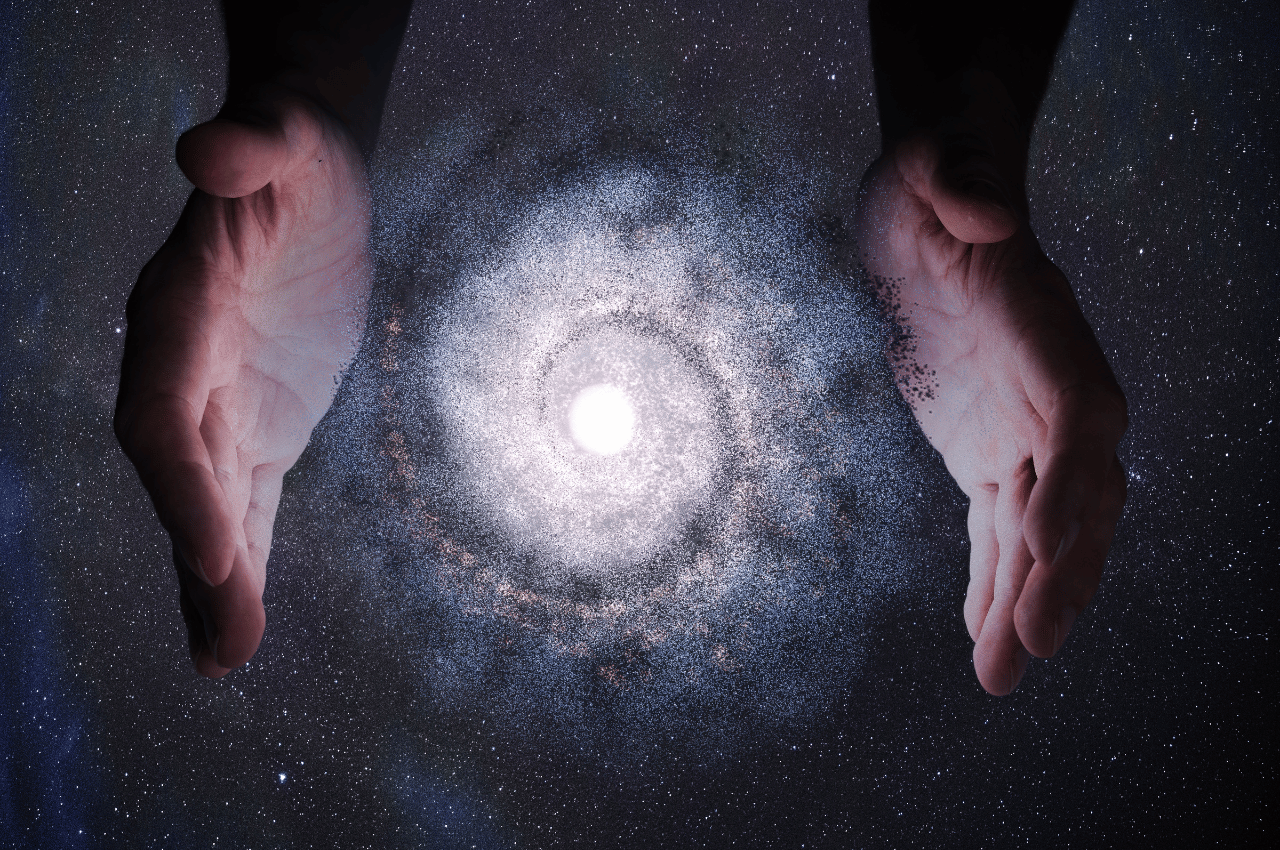
This passage captures a central theme of Qur’anic reflection: the correspondence between the microcosm of human existence and the macrocosm of the universe.
Human development within the womb reveals patterns of order and transformation that mirror the processes observable within the larger universe. Both biological development and cosmic evolution unfold through stages governed by proportion and structure.
Islamic philosophers later elaborated this concept of correspondence between microcosm and macrocosm. Classical metaphysical traditions frequently described the human being as a “small world” (ʿālam ṣaghīr) reflecting the structure of the larger cosmos. Such ideas appeared in various strands of Islamic philosophical and mystical thought, where the human being was sometimes portrayed as a mirror through which the patterns of creation become intelligible.
Modern discussions concerning the relationship between science and religion have revisited similar themes. Scholars working in this field have argued that religious cosmologies often function not as scientific alternatives but as frameworks that give philosophical meaning to scientific knowledge. Ian G. Barbour, for example, emphasizes that scientific and religious perspectives operate at different yet complementary levels of explanation, with science investigating empirical processes while religion explores questions of meaning and ultimate purpose. Nidhal Guessoum similarly argues that Islamic theology and modern cosmology need not be in conflict; instead, they can engage in constructive dialogue in which scientific discoveries deepen appreciation for the complexity of creation. Mehdi Golshani has likewise emphasized that the Qur’anic encouragement to reflect upon nature historically stimulated intellectual inquiry in the Muslim world and continues to inspire philosophical reflection on the relationship between scientific knowledge and metaphysical questions.
Scholars in the field of science-and-religion studies have further emphasized that scientific and religious explanations operate at different levels of inquiry. Historians such as John Hedley Brooke and Peter Harrison have shown that the perceived conflict between science and religion often arises from modern conceptual distinctions rather than from historical reality.
Within this broader intellectual conversation, the Qur’anic invitation to contemplate both the horizons and the self can be understood as encouraging a form of integrated knowledge in which empirical observation and philosophical reflection mutually reinforce one another. Thinkers such as Ibn Arabi and later philosophical theologians described the human being as a miniature reflection of the cosmos—a microcosm containing within itself the patterns present in the wider universe.
While these philosophical developments extend beyond the Qur’anic text itself, they illustrate how the Qur’anic invitation to reflect on both the self and the cosmos inspired a rich tradition of intellectual exploration.
Conclusion: Signs in the Horizons and Within Ourselves
The Qur’anic vision of creation directs human reflection toward two interconnected domains: the development of human life within the womb and the structure of the cosmos. Although these domains differ dramatically in scale, the Qur’anic discourse presents them as complementary manifestations of a single underlying order. The microcosm of human development and the macrocosm of the universe both reveal patterns of proportion, transformation, and intelligibility that invite contemplation of the unity of creation.
The Qur’anic description of embryonic development portrays human creation as a sequential process unfolding through distinct stages governed by proportion and transformation. Beginning with the fertilized drop (nutfah), progressing through the stages of ʿalaqah and mudghah, and culminating in the formation of bones and flesh, human development appears as an ordered progression through which life emerges from simple beginnings.
Qur’anic cosmological passages similarly emphasize structure, balance, and dynamic process. The cosmos is described as created according to measure, sustained through harmonious relationships, and characterized by motion and transformation. Celestial bodies move in defined courses, the heavens are portrayed as vast and expanding, and the universe itself is depicted as emerging from an initial unity before unfolding into increasingly complex structures.
These passages are not intended to articulate scientific theories in the modern sense. Rather, they express a broader philosophical vision of creation as an ordered and intelligible reality. Natural phenomena are presented not as isolated curiosities but as signs (āyāt) that point toward the coherence of the created world.
When considered together, the Qur’anic descriptions of embryological development and cosmic structure reveal a striking conceptual symmetry. Processes observable within the human body reflect patterns that also appear within the larger architecture of the universe. Both domains exhibit gradual transformation, proportion, and interdependence. The formation of a human being within the womb and the unfolding of the cosmos across immense spans of time are thus portrayed as parallel manifestations of a unified creative order.
This correspondence between the microcosm and the macrocosm is captured in the verse:
سَنُرِيهِمْ آيَاتِنَا فِي الْآفَاقِ وَفِي أَنفُسِهِمْ
“We will show them Our signs in the horizons and within themselves.” (Qur’an 41:53)
The verse suggests that understanding emerges through the combined contemplation of both realms. The signs revealed in the structure of the universe and those manifested within human life are not separate phenomena but interconnected expressions of the same creative reality.
From this perspective, the study of nature becomes a form of intellectual and philosophical inquiry. The natural world provides a field of observation through which deeper questions concerning order, origin, and purpose may be explored. Rather than opposing empirical investigation, the Qur’anic worldview encourages sustained reflection upon the patterns embedded within creation.
Contemporary discussions in the philosophy of science increasingly recognize that scientific inquiry itself rests upon underlying assumptions concerning the intelligibility and regularity of the natural world. The expectation that nature operates according to discoverable patterns and laws has historically motivated the development of scientific investigation across cultures. Scholars working at the intersection of science and religion have noted that religious cosmologies can contribute to this intellectual orientation by portraying the universe as a coherent and ordered reality open to rational exploration.
Modern scientific research has greatly expanded human knowledge of both embryology and cosmology. Yet the fundamental intuition emphasized in the Qur’anic text—that both human life and the universe exhibit structure, order, and intelligibility—remains central to contemporary scientific inquiry. The laws governing biological development and the physical processes shaping the cosmos both reveal a universe characterized by patterned relationships and dynamic transformation.
Ultimately, the Qur’anic reflections on creation aim less to provide technical explanations than to cultivate a particular mode of perception: one that recognizes unity within the diversity of natural phenomena. By directing attention simultaneously to the formation of human life and to the vast architecture of the cosmos, the Qur’anic discourse invites readers to perceive creation as an interconnected whole.
The signs in the horizons and the signs within ourselves thus converge in a single insight: the natural world—from the smallest beginnings of human life to the immense expanse of the universe—reflects an underlying order that invites continual reflection and discovery.